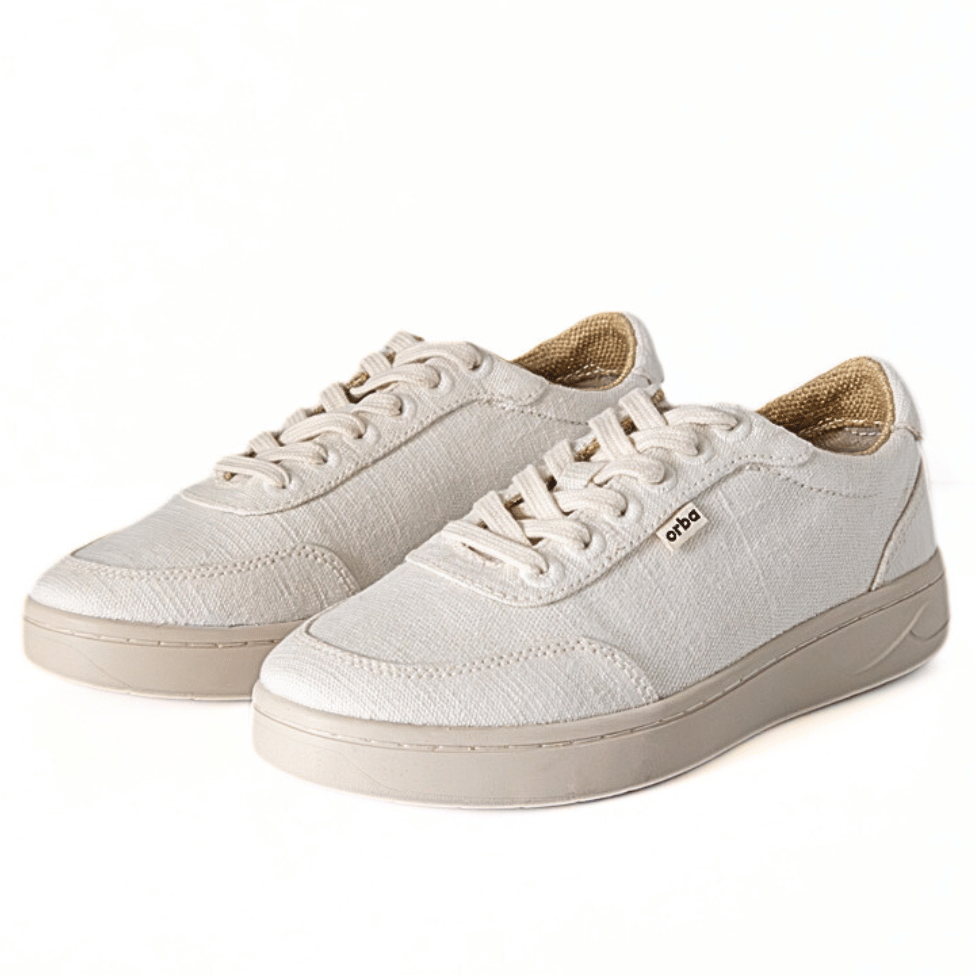

Whitepaper 1.3 - Orba’s approach, results, pathway forward.
Lessons. Learning. How we raise standards.
Shoes are designed once and then can be repeated millions of times. With global production of around 24 billion pairs each year, small improvements at the individual product level compound into very large system-level effects. If footwear across the industry were produced with a footprint comparable to Orba’s level, the reduction would be in the order of hundreds of millions of tonnes of CO₂ per year, which is potentially around 1.0% of total global emissions.
Orba measured the carbon footprint of its first Ghost sneaker using an ISO-aligned, cradle-to-grave Life Cycle Assessment. The initial result showed a footprint of 7.8 kg CO₂-equivalent per pair, with a clear pathway for 2026 to reduce this to below 5.0 kg. This compares with around 14 kg for a benchmark running shoe, an estimated industry average of 27 kg per pair, and more than 40 kg for many leather shoes.
This white paper explains how the footprint was measured, what was included, how the results compare with widely cited industry benchmarks, how the further reductions are realistically achievable, and the potential benefits of doing so. It also discusses how a small, early-stage business can afford and achieve these results.
The intent is for a transparent, repeatable framework that allows progress to be measured as Orba continues to improve its materials, processes, and end-of-life systems. The framework aligns with relevant United Nations Sustainable Development Goals, particularly those relating to responsible production, climate action, and waste reduction.
Orba’s approach focuses on material choice, durability, and circular end-of-life pathways, because these are the areas where design decisions have the greatest leverage.
This paper forms part of Orba’s series “Lessons. Learning. How we raise standards”. It is intended to be useful to Orba and to others seeking to understand, challenge, or improve how product-level carbon footprints are measured and reduced, especially in early stage, aspirational businesses.
For Orba Shoes (Linax Limited t/as),
 Scott Anderson
Cofounder, operations, finance.

Key findings.
The footwear industry has the potential to reduce its emissions impact from contributing approximately 1.4% of global emissions to closer to 0.4%, if lower-footprint shoe designs were adopted at scale.
At global scale, reducing footwear footprints from industry-average levels to Orba’s level implies a reduction in the order of hundreds of millions of tonnes of CO₂ per year is possible. This shows why design decisions made once can have large effects when repeated across millions of pairs of shoes.
Orba’s Ghost sneaker has an initial measured carbon footprint of 7.8 kg CO₂-eq per pair, based on a cradle-to-grave Life Cycle Assessment (LCA).
This is approximately one quarter of the estimated industry average for conventional footwear (27 kg CO₂-eq), and one fifth of many leather shoes.
A widely cited benchmark running shoe (ASICS, 2014) estimated a footprint of 14 kg CO₂-eq, around 1.8× higher than Orba’s current result.
Raw materials account for the majority of footwear emissions, highlighting raw material choice as the single most important driver of reduction.
Orba has a pathway to reduce its footprint to below 5.0 kg CO₂-eq per pair in 2026, primarily through increased use of renewable and waste-stream inputs and validated end-of-life pathways.
This approach supports practical alignment with the UN Sustainable Development Goals, particularly SDG 9 (Industry, Innovation and Infrastructure), SDG 12 (Responsible Consumption and Production) and SDG 13 (Climate Action), through measurable product-level outcomes.

1. Purpose.
This white paper sets out Orba’s approach to measuring the carbon footprint of footwear, the results of its product Life Cycle Assessment (LCA), how those results compare with industry benchmarks, and how Orba is reducing the product footprint further. It also explains the methodology used, the assumptions made, and the limitations of the current data.
The purpose is to establish a transparent, repeatable framework that supports a measurable, continual process of improvement, and is intelligible to customers, suppliers, regulators, and climate- and impact-focused investors. While further reductions are preferable, in cases where product footprint cannot be improved further, the LCA provides a yardstick against which any residual emissions can be assessed and, if appropriate, offset.
2. Carbon footprint and footwear: why measurement matters.
Footwear is one of the most material and process intensive everyday consumer products. A typical shoe incorporates dozens of distinct materials, including polymers, rubbers, textiles, foams, adhesives, dyes, and reinforcements. These materials are sourced globally, processed through energy-intensive manufacturing steps, assembled across multiple facilities, transported internationally, and ultimately disposed of with limited recovery options.
Despite this complexity, the footwear industry has historically relied on partial or inconsistent carbon reporting, often limited to manufacturing emissions or headline material claims. Full product-level carbon footprints are still relatively uncommon, and where they exist, they are often difficult to compare due to differences in scope, assumptions, and data quality.
Orba’s position is that measurement must come before claims, and that publishing our methods matters as much as publishing our numbers.
3. Footwear in context: comparison with other everyday consumer products.
In discussions about carbon footprint, footwear is often treated as similar to other everyday consumer products. In practice, it presents a different series of challenges.
Many common consumer goods, such as basic apparel or simple household items, have been the subject of carbon measurement and simplification for decades. As a result, their material systems, manufacturing pathways, and end-of-life assumptions are relatively well understood and easier to model.
Footwear has received less consistent treatment. Where full product-level assessments exist, they tend to show greater variation in results, reflecting the higher sensitivity of footwear footprints to modelling choices and data quality.
This observation is reflected across multiple independent perspectives:
- Academic footwear LCAs, including work undertaken through MIT1 and similar institutions, highlight higher uncertainty and variability in footwear footprints compared with simpler consumer products.
- European circular economy policy frameworks2 treat footwear as a priority category because it is difficult to address using standard recycling or recovery approaches.
- Circular economy organisations, including the Ellen MacArthur Foundation, regularly identify footwear as a category where circular solutions lag3 behind intent, due to structural design constraints rather than lack of effort.
Taken together, these perspectives do not suggest that footwear is uniquely problematic, but that it is less mature as a category for consistent measurement and reduction. This is why Orba places particular emphasis on explaining methodology, publishing assumptions, and repeating assessments over time.
4. What a carbon footprint represents.
A carbon footprint, measured in kilograms of carbon dioxide equivalent (kg CO₂-eq), expresses the combined climate impact of multiple greenhouse gases across defined system boundaries, including time and scope boundaries as discussed below.
Gases such as methane and nitrous oxide are converted into a common unit of measurement based on their global warming potential over a standard time period, typically a time boundary of 100 years4 . In this context, the system scope boundary defines which stages of a product’s life are included in the calculation.
For products such as footwear, scope boundaries typically include:
- Emissions from raw material extraction and processing.
- Manufacturing and assembly energy use.
- Packaging.
- Transport and distribution.
- End-of-life treatment.
What is included, and what is excluded, depends on the choice of system boundaries. This has a material effect on reported carbon footprints, and can make direct comparison between products difficult. This is why transparency and consistency are essential for meaningful comparisons of products.
5. Orba’s measurement methodology.
5.1 Life Cycle Assessment framework.
Product-level carbon footprints are most commonly measured using a Life Cycle Assessment (LCA) conducted in accordance with ISO 14040 and ISO 14044, the internationally recognised standards for life-cycle studies. This approach is widely regarded as best practice for assessing the full climate impact of physical products.
Other approaches also exist. These include partial foot-printing, input-output modelling, or reporting limited to specific stages of production. Such methods can exclude significant sources of emissions or rely on higher-level averages, which may reduce accuracy and make results harder to compare.
Orba measures its carbon footprint using an ISO-aligned Life Cycle Assessment that follows a cradle-to-grave approach. This means impacts are considered from raw material extraction through to end-of-life disposal. This is more comprehensive than cradle-to-gate studies, which stop at the factory gate and exclude use and disposal.
5.2 Product definition and functional unit.
The assessed product is an Orba Ghost sneaker, size EU42, chosen to align with common industry practice and published footwear LCAs. The functional unit is one complete pair of shoes, including packaging.
5.3 Data sources and quality.
In an ideal assessment, primary data is obtained directly from suppliers and manufacturing partners, including material compositions, weights, manufacturing locations, and process descriptions.
In practice, this is often not possible, particularly in industries such as footwear in Southeast Asia, where product-level carbon measurement is still emerging and consistent data collection systems are a work-in-progress, but not yet fully in place.
For this assessment, Orba relied on secondary data sourced from established life-cycle databases and specialist third-party providers, as referenced in the LCA.
These data sets represent geographically and materially recognised emission factors, derived from industry and process-level averages, and are commonly used where primary data is unavailable.
5.4 U.N. Sustainable Development Goals.
Orba aligns its work with relevant SDGs. This places product-level and design decisions within a broader, internationally recognised context, and recognises that no single product or company can address these challenges alone. Meaningful progress requires coordinated effort across the wider system.
The United Nations Sustainable Development Goals (SDGs) provide a shared global framework for addressing environmental, social, and economic challenges. Established in 2015 and building on the earlier Millennium Development Goals, the SDGs reflect the understanding that global problems require coordinated action across governments, businesses, and communities.
6. Impact assessment and reporting.
The impact assessment was completed in September 2024 using ISO-aligned life-cycle assessment software. All emissions associated with one pair of shoes are converted into a single CO₂-equivalent figure so they can be compared consistently.
The initial Life Cycle Assessment shows that the Orba Ghost sneaker has a carbon footprint of 7.8 kg CO₂-equivalent per pair. This figure represents Orba’s current baseline. It is not a minimum, and it reflects work in progress rather than a final outcome.
The full assessment is available: Orba LCA – Final Report (23 Sep 2024) .
7. Where Orba’s emissions occur.
The LCA identifies the following approximate contribution ranges:
-
Raw materials (57%)
Including rubber compounds, textiles, cork, and other components. -
Manufacturing and assembly (32%)
Energy use, processing, and assembly operations. -
Packaging, transport, and end of life (11%)
Including international freight and disposal assumptions.
This distribution highlights the importance of material choice as the primary driver of product-level carbon footprint.
8. Areas where improvement is most possible.
Not all sources of emissions are equally controllable, particularly for small, early-stage companies such as Orba, despite the best will in the world. In areas such as manufacturing energy use, international freight, warehousing, and customer usage behaviours (such as cleaning), Orba operates within broader industry and societal systems and infrastructure.
While conscious supplier selection, process development, and efficiency improvements have and can continue to reduce impact at the margin, Orba has limited ability to change underlying industry norms or energy systems on its own.
A partial exception is the end-of-life process. Through the work-in-progress development of the “Sole to Soil” and “MulchMe” disposal programmes, Orba can globally influence how plant-based, non-toxic consumer products are treated once they are no longer in use. These processes are designed to make it easy for consumers to dispose of product and avoid landfill and other higher-impact disposal routes, and to enable a further lowering of emissions.
While end-of-life treatment is a relatively small contributor to Orba’s overall product footprint, scenario analysis indicates that soil-based disposal pathways can materially reduce disposal-stage emissions5 compared with landfill or complex recycling. Depending on modelling assumptions, this could reduce Orba’s total product emissions by approximately 5–8%.
By contrast, Orba does have a high degree of influence over its material selection and formulation. Choices made at the design and material stage determine a large proportion of upstream emissions and shape all subsequent stages of the product life cycle.
For these reasons, Orba’s primary reduction strategy focuses on:
- increasing the proportion of renewable, regenerative, and waste-stream inputs,
- reducing reliance on high-impact virgin materials, such as plantation-grown latex rubber,
- improving material efficiency without compromising durability or performance,
- continuing to develop and commercialise end-of-life processes.
This focus reflects both the LCA results and a practical assessment of where meaningful, repeatable reductions can be achieved within Orba’s control.
9. Industry benchmarks and comparisons.
Published carbon footprints for footwear vary widely, reflecting differences in materials, manufacturing processes, and system boundaries. However, several widely cited benchmarks provide useful context for comparison.
A commonly referenced benchmark is the ASICS running shoe LCA published in 2014, which reported a footprint of approximately 14 kg CO₂-equivalent per pair. By comparison, Orba’s initial footprint of 7.8 kg CO₂-eq per pair is around 56% of this benchmark, meaning the ASICS footprint is 1.8 times higher than Orba’s.
Across the wider market, aggregated datasets suggest that the average carbon footprint of a conventional shoe is in the order of 27 kg CO₂-eq per pair, depending on category and assumptions. On this basis, Orba’s footprint represents roughly 29% of an average shoe, and the average shoe footprint is approximately 3.5 times higher than Orba’s.
Footwear made with animal leather typically sits at the higher end of the range. Published estimates indicate that leather shoes can exceed 40 kg CO₂-eq per pair, driven largely by emissions associated with livestock production and energy-intensive tanning processes. The Orba Ghost’s footprint equates to around 19% of the footprint of a typical leather shoe, or the typical leather shoe’s footprint is five times higher than Orba’s.
At the extreme upper end, some footwear products have been reported with footprints approaching 40 to 80 kg CO₂-eq per pair6 , depending on materials, complexity, and scope. These products can be 5 to more than 10 times more carbon-intensive than Orba’s current footprint, illustrating the scale of variation within the industry.
10. Implications at industry scale.
The global footwear industry is estimated to account for approximately 1.4% of global greenhouse gas emissions7 , largely due to material intensity, production volume, and reliance on petrochemical and animal-derived inputs.
In comparison, the global footwear industry represents an estimated 0.15–0.20% of global GDP8 . This implies that footwear is around 7 to 9 times more carbon intensive than the global economic average.
If product-level footprints across the industry were reduced to levels comparable with Orba’s current baseline, the potential impact would be significant. A reduction from an industry-average footprint (27 kg CO₂-eq per pair) to Orba’s level (7.8 kg CO₂-eq) represents a reduction of approximately 70% per pair.
Applied at scale, this would imply a potential reduction in global emissions of around 1.0%, meaning footwear would then reduce its contribution to 0.4% of global emissions, subject to adoption rates, product mix, and system boundaries.
These comparisons illustrate why Orba’s approach is not framed as marginal improvement, but is a model for what is technically achievable when material choice, design, and end-of-life are addressed together.
11. Translating carbon footprint into everyday terms. Why small differences matter.
To make carbon footprint measurements more understandable it helps to translate them into a comparison with familiar, everyday activities. With the example of a typical 2-litre petrol car, the relative scale of footwear product manufacturing can be illustrated as follows:
- Orba Ghost – 7.8 kg CO₂-eq per pair, equivalent to driving 35–40 kilometres.
- ASICS benchmark running shoe (2014) – 14 kg CO₂-eq per pair, equivalent to driving 65–70 kilometres.
- Average conventional shoe – 27 kg CO₂-eq per pair, equivalent to driving 120–135 kilometres.
- Leather shoe – 40 kg CO₂-eq per pair, equivalent to driving approximately 180–200 kilometres.
While these distances are modest, at total footwear industry scale the impacts compound rapidly.
If the industry achieved a footprint reduction comparable to Orba’s target level of 5 kg CO₂-eq per pair across global production of around 24 billion pairs per year9 , this represents a theoretical reduction of approximately 530 million tonnes of CO₂-eq annually, comparable to removing over 100 million 2 litre petrol cars from the road.
All comparisons are indicative and depend on assumptions about system boundaries and vehicle efficiency.
12. How Orba can reduce its footprint further.
Orba’s stated objective is to reduce its product footprint from 7.8 to below 5.0 kg CO₂-eq per pair, representing a further reduction of around 35% from the current baseline.
The primary pathway to this reduction is through our work-in-progress innovation in renewable materials, specifically:
- Increasing the proportion of waste-stream inputs in the sole compound to around 60%.
- Reducing reliance on higher-impact virgin materials, for example reducing natural latex to around 25%.
- Maintaining style, durability, and performance so shoes are worn for their full intended life rather than needing premature replacement.
Secondary contributions are expected from:
- Improved supplier-specific data as their measurement systems mature.
- Process optimisation as production volumes increase.
- Refined end-of-life modelling as soil-based disposal pathways are validated.
We intend to repeat a full ISO-aligned Life Cycle Assessment in 2026 to measure progress against this objective.

13. Internal capability and cost control.
Conducting a robust, ISO-aligned Life Cycle Assessment can be prohibitively expensive for early-stage companies such as Orba, particularly where external consultants are relied on for scoping, modelling, and interpretation.
To address this, Orba invested in building its internal capability. Gillian Boucher, the co-founder of Orba with responsibility for sustainability, completed MIT Professional Education’s online course Life Cycle Assessment: Quantifying Environmental Impacts10 , providing a foundation for applying the internationally recognised ISO 14040 life-cycle method to product-level assessment.
This enabled Orba to clearly define which parts of a product’s life are included in the calculation, prepare product-specific inputs such as material weights and manufacturing processes, and manage
the assessment internally. Orba engaged Carbon Trail to provide their LCA modelling software, access to recognised life-cycle databases, and provide the independent calculation of the product carbon footprint in line with ISO 14067.
Carbon Trail provides a software-based platform for fashion and footwear-focused product footprinting and LCAs11 . Carbon Trail states that its methodology is aligned with ISO 14067 and the Apparel & Footwear PEFCR, and that it uses secondary datasets and supplier/facility data (where available), with data gaps flagged and managed transparently.
This assessment relates to the carbon footprint of a specific product, the Orba Ghost sneaker (size EU 42), and not to the emissions of the organisation as a whole. Organisational emissions, which would be measured under a different standard (ISO 14064), are not relevant to Orba as an early stage business.
As a result, external costs for the 2024 assessment were reduced from an estimated NZ$ 30,000 to approximately $5,000, excluding internal labour.
This approach supports repeatable measurement and continuous improvement, rather than one-off reporting.
14. Limitations and future improvements.
As with all LCAs, the current assessment includes assumptions and limitations, particularly where secondary data is used. Orba treats this assessment as a baseline, not an endpoint.
Future assessments, including the re-assessment aimed for 2026, will aim to:
- Increase reliance on primary supplier data where available.
- Refine end-of-life scenarios as disposal pathways are validated.
- Expand beyond carbon to include additional environmental indicators.
15. Alignment with the UN Sustainable Development Goals.
The United Nations Sustainable Development Goals (SDGs) provide a common reference point for governments, businesses, and civil society to address shared global challenges.
Orba’s work on measuring and reducing footwear carbon footprints aligns most directly with:
- SDG 12 – Responsible Consumption and Production, by improving transparency, material efficiency, and end-of-life outcomes at product level.
- SDG 13 – Climate Action, by measuring, publishing, and reducing greenhouse gas emissions associated with footwear.
- SDG 9 – Industry, Innovation and Infrastructure, through material innovation and scalable product design approaches.
Orba treats SDG alignment as a framing reference rather than a certification or claim, recognising that progress on global challenges requires coordinated action across the wider global community.
16. Carbon as part of a broader picture.
Carbon footprint is a useful and widely recognised metric, particularly for comparing climate impacts across products and industries. However, it captures only one dimension of environmental performance.
Orba’s longer-term objective is to progressively account for additional impact areas where footwear has material consequences, including water use, toxicity, soil impact, resource depletion, and waste.
These factors often interact with carbon outcomes but are not always aligned; improvements in one area can sometimes increase impacts elsewhere.
For this reason, Orba treats carbon as a starting point rather than a proxy for overall sustainability. During 2026, as data availability and measurement methods improve, Orba intends to expand its assessment framework to provide a more complete, transparent view of product performance across multiple environmental dimensions.
17. Conclusion.
Orba’s current carbon footprint of 7.8 kg CO₂-eq per pair reflects deliberate design and material choices, and provides a transparent, defensible baseline from which to improve.
More importantly, it demonstrates that product-level measurement in footwear is both possible and useful, even in a complex, global supply chain. By measuring carefully, explaining methodology, and publishing assumptions, Orba aims to contribute to better understanding and comparability across the industry.
By repeating assessments over time and focusing on areas of genuine influence, Orba seeks to demonstrate that meaningful reductions in footwear emissions are achievable without compromising durability, comfort, or affordability.
For Orba Shoes (Linax Limited t/as),

Scott Anderson
Cofounder, operations, finance.
About Orba
Orba (Linax Limited t/a) is a pioneer in renewable materials, designing materials and making products that address the global synthetic waste crisis, starting with shoes.
Our first product, the multi-award-winning Orba Ghost sneaker, is “the shoe that leaves no trace.” Designed in New Zealand and made in Indonesia, the Ghost is crafted to biodegrade and compost at end-of-life, without compromising on style, quality, or durability.
Orba addresses the problem from the 24 billion synthetic shoes produced annually, which leave behind waste lasting over 200 years. Disposed globally, the volume of this waste could fill a line of Olympic pools that wraps around the Earth 2.4 times before typical shoes biodegrade.
To solve this, Orba avoids petrochemicals, synthetics, plastics, metals, and forever chemical, replacing them with renewable plant-based materials that are non-toxic, high-performing, and cost-effective. The 10+ science-based materials innovations in our products includes our sole, made with Orba’s proprietary rubber compound, the world’s first to achieve USDA bio-based certification at 95%+, using natural latex, plant oils and waste-stream inputs.
Orba is a certified B Corporation and operates to high social and environmental standards. We support ethical manufacturing and sourcing, prioritizing suppliers certified by Fair Trade and the Global Organic Textile Standard. When certification is unaffordable for small producers, we partner with labour organizations to help improve their practices and support sustainable growth.
Orba’s vision is an industry free of pollution and waste, where good products deliver environmental, social, and commercial value. Our goal is to be a leader in renewable materials, measured by certification, revenue, reach, and real-world impact, by 2030.
References:
1. MIT Materials Systems Laboratory. Life Cycle Assessment research and teaching materials on footwear and consumer products. Massachusetts Institute of Technology. View source
2. European Commission (2020). A New Circular Economy Action Plan. European Union. View source
3. Ellen MacArthur Foundation (2019). Completing the Picture: How the Circular Economy Tackles Climate Change. Ellen MacArthur Foundation. View source
4. IPCC (2021). AR6 Working Group I - Climate Change 2021: The Physical Science Basis. Intergovernmental Panel on Climate Change. View source
5. IPCC (2019). 2019 Refinement to the 2006 IPCC Guidelines for National Greenhouse Gas Inventories – Waste. Intergovernmental Panel on Climate Change. View source
6. MIT Materials Systems Laboratory. Footwear life-cycle assessment case studies, including high-complexity and safety footwear. Massachusetts Institute of Technology. View source
7. Quantis (2018). Measuring Fashion: Environmental Impact of the Global Apparel and Footwear Industries. Quantis International. View source
8. Global GDP data sourced from the World Bank World Development Indicators. Global footwear production value sourced from APICCAPS World Footwear Yearbook (latest edition). Percentage calculated by comparing reported global footwear market value to total global GDP. View source
9. World Footwear Yearbook (latest edition). Global footwear production statistics. APICCAPS. https://www.worldfootwear.com/yearbook.html
10. MIT Professional Education. Life Cycle Assessment: Quantifying Environmental Impacts. Massachusetts Institute of Technology. View source
11. Carbon Trail. Product carbon footprinting and life-cycle assessment platform for fashion and footwear. Carbon Trail (India). View source