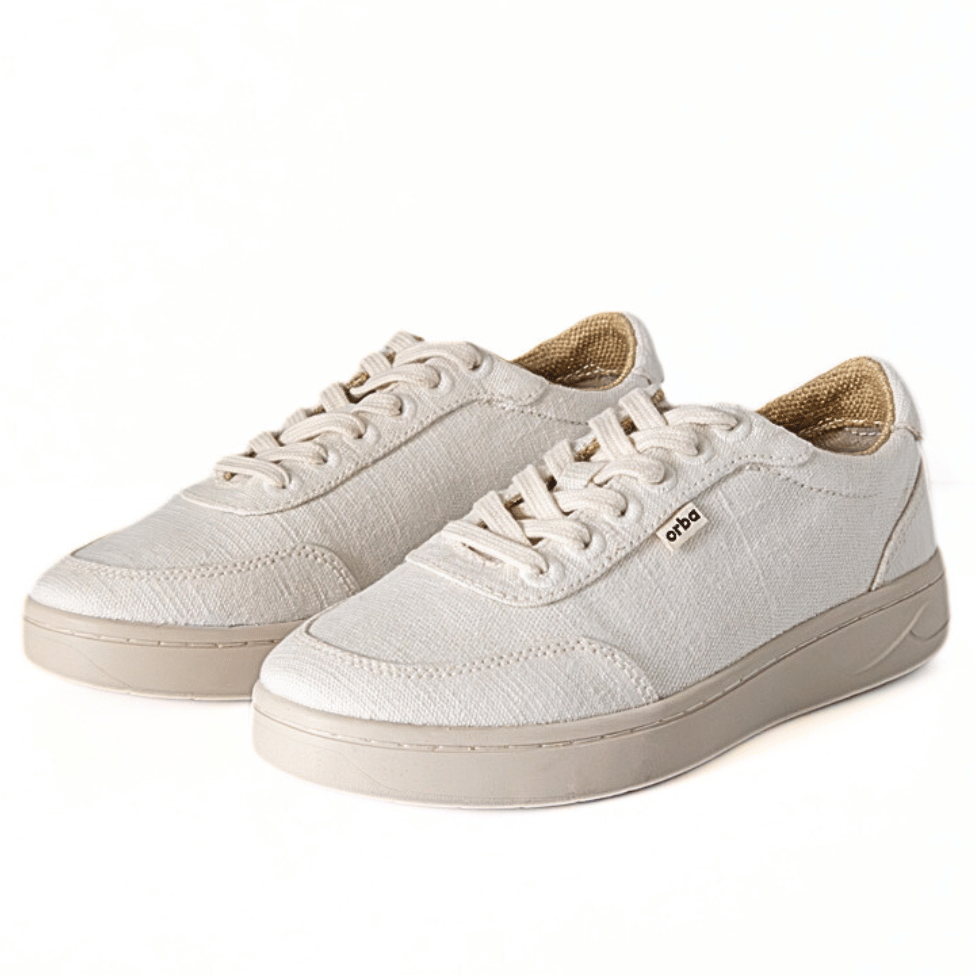

A case study of Orba’s biorubber development.
Lessons. Learning. How we raise standards.
Orba’s bio-rubber sole eliminates forever chemicals and reduces physical persistence in shoe soles from an estimated average of about 200 years to around two years. We expect to be able to certify this achievement with independent testing currently underway.
This case study records progress in one of Orba’s ten areas of innovation: the development of bio-based rubber as a solution to one of the most neglected problems in the global footwear industry, the centuries-long persistence of synthetic rubber outsole waste.
Since 2018, the objective has been to create an outsole material that does not compromise style, comfort or durability, and is capable of biodegrading and composting after disposal without leaving toxic, forever chemical or microplastic residues.
At global scale, with around 24 billion pairs of shoes produced each year, a single design decision can be repeated billions of times. At these volumes, synthetic waste accumulates year after year, generation after generation. The waste will fill a line of Olympic swimming pools long enough to wrap 2.4 times around the earth, before a pair of synthetic shoes made today has degraded.
Achieving this required redesign across raw material inputs, design and manufacturing processes. Development work involved functional testing across more than 16 prototype iterations evaluating the performance expected of a commercial shoe sole.
Production-scale lessons also emerged during early manufacturing. In one run, part of a black sole batch used conventional carbon black rather than the specified bio-char filler proven in prototypes. In another, a white sole batch aimed at vegan certification produced a softer compound that fell below the intended abrasion durability target. These were manufacturing oversight issues rather than design failures, but they reinforced an important operational reality:
“Raising environmental standards also raises engineering and manufacturing discipline.”
The program described here forms part of Orba’s “How we raise standards” development direction: redesigning a material historically associated with waste persistence measured in centuries so that its useful life remains durable in use, but temporary in soil.
For Orba Shoes (Linax Limited t/as),
 Scott Anderson, cofounder, operations, finance.

Key findings.
Synthetic rubber that persists for about 200 years after use has been redesigned using plants to return harmlessly to soil in about two years. That is the central development direction of the Orba “beautiful sole” program: maintaining durability in use while reducing long-term persistence after disposal.
Persistence creates chemical exposure risks. Many conventional footwear materials contain additives and processing chemicals that can remain in soils and environments long after disposal. As materials fragment and degrade, these substances may disperse into surrounding environments (see e.g. The Lancet Commission on pollution and health).
End-of-life behaviour must now be a design metric. Footwear materials have historically been engineered for performance in use, with little consideration of what happens after disposal.
Material inputs determine environmental outcomes. Conventional fillers such as carbon black dominate rubber compounding, while alternatives such as rice husk ash and bio-char offer lower-impact options now being explored.
Scale magnifies design decisions. With around 24 billion pairs of shoes produced each year, changes to outsole materials can influence global waste outcomes at very large scale.
Prototype success does not guarantee production success. Early manufacturing revealed two scale-up issues: use of carbon black instead of specified bio-char in part of one black compound batch, and inconsistent softness and abrasion performance in one off-white compound batch.
Environmental innovation raises operational standards. Delivering lower-impact materials requires tighter specifications, stronger traceability, better training, repeated testing and disciplined production control.
Testing frameworks must evolve. Existing biodegradability standards such as ISO 14855 focus on controlled composting conditions. Emerging bio-based rubber materials may require additional methods to assess behaviour across real disposal environments.
Introduction.
Footwear must be stylish, comfortable and durable in use. With the development described in this case study, it can now also leave no trace on disposal.
Around 24 billion pairs of shoes are produced globally each year, most using synthetic polymers, synthetic rubber, plastics, adhesives, dyes and additives chosen primarily for cost, appearance, manufacturing efficiency and durability in use.
At that scale, design decisions matter. Products designed once are repeated billions of times, and waste designed once is also repeated billions of times. Simple maths shows that synthetic footwear waste would fill a line of Olympic swimming pools long enough to wrap around the Earth 2.4 times in the 200 years before a typical pair decomposes. Despite this scale, the physical and chemical persistence of footwear materials after disposal has historically received almost no design attention.
Charles Goodyear patented vulcanisation in 1844, beginning the transformation of rubber into one of the most useful materials of the emerging industrial age. Synthetic rubber was patented by German scientists in 1935, extending rubber into an even more controllable, scalable and versatile material. Since then, rubber technology has been optimised for endurance and functionality in service, not for safe return to soil at end of life. The chemistry that made rubber resilient in use also made it highly persistent after disposal.
This case study records part of Orba’s process of innovation and development toward helping to change that outcome. It documents the drivers of the program, the technical constraints, the materials choices, the milestones, the setbacks, the scale-up issues, and the pathway toward a sole material designed to reduce waste persistence from centuries toward approximately two years under managed end-of-life conditions.
That direction is described as 200 to Two.
1. Purpose.
This case study sets out Orba’s approach to the development of bio-rubber for footwear soles, the development objectives, the materials strategy, the testing undertaken, the issues encountered, and the pathway forward.
The purpose is fourfold:
- Create a transparent internal and external development record.
- Provide a repeatable framework for future iterations by current and future staff, partners and technical advisers.
- Support intellectual property, patent and know-how protection by recording the logic of the development pathway.
- Be useful to others working on renewable and regenerative materials aimed at reducing persistent synthetic pollution.
As with Whitepaper 1.3, on CO2 and Life Cycle Assessment, the objective is to transparently record the method, the assumptions, the limits and the direction of future travel.
2. Why biodegradation matters.
Footwear is a deceptively complex everyday product. A traditional shoe can involve more than 40 materials, processes and components, often sourced globally, processed across multiple sites, and ultimately disposed of with limited recycling or recovery.
Waste occurs across the full lifecycle: resource extraction, raw materials processing, manufacturing, use and disposal.
Because the footwear sector operates at very high volume, even small improvements in materials or design can create large system effects over time.
Biodegradation is fundamental to Orba’s design approach. If waste from shoes remains in the environment for around 200 years, each year’s production and disposal adds to what came before. So, every year of inaction counts.
By contrast, if materials and products are designed to biodegrade and compost safely after use, the stock of accumulated waste can be reduced and ultimately eliminated. This approach draws inspiration from traditional materials systems, such as banana leaves as used for wrapping before plastics became common, which returned harmlessly to soil after use.
Fundamentally, biodegradation is nature’s system for recycling materials. In natural systems, materials return to soil through biological processes. Modern materials design should aim to work with those cycles rather than compete against them by creating materials that persist outside them.
Whitepaper 1.3 established Orba’s product carbon baseline. This case study addresses time and end-of-life behaviour. Carbon asks how much impact a product creates. Biodegradation asks how long the waste remains, and what it leaves behind.
Orba’s public framing has been that global shoe waste is large enough to fill a line of Olympic swimming pools that would wrap around the Earth about 2.4 times before a typical synthetic pair breaks down. The exact analogy depends on assumptions about pair volume, disposal route and degradation rate, but the systems point remains sound: at the scale of the footwear industry, the physical persistence of footwear waste is a problem that must be solved.
3. Rubber in context as an everyday product.
Rubber is one of the foundational materials of modern industrial life. Vulcanisation, patented in 1844, made it useful because it reduced stickiness, improved elasticity across temperature ranges, and increased durability.
That is why rubber and rubber-like materials became central to tyres, seals, toys, shoe soles, hoses, belts and countless consumer and industrial products.
From a performance perspective, that success is obvious. From an end-of-life perspective, it creates a different problem. The same chemistry that helps rubber survive wear, heat, moisture and oxidation also tends to make it extremely resistant to breakdown after disposal.
That is why Orba’s development challenge is not merely to make rubber biodegradable. It is to redesign a material system so that it still performs as a shoe sole, while changing what happens after the shoe’s useful life is over.
4. Plastics and synthetic materials in footwear.
Modern footwear commonly uses synthetic rubber types such as SBR, BR and NBR, alongside plastics and foams such as EVA, PU and TPU in different parts of the shoe.
These materials became dominant because they are consistent, scalable and relatively inexpensive, and because they can be tuned to deliver grip, resilience, colourability and abrasion resistance.
The environmental cost is that many of these materials are fossil-derived and persist for centuries after use.
For Orba, that persistence is one of the design outcomes the company is trying to change.
5. What biodegradation means, and what it does not mean.
The term biodegradable is often used, or misused, casually in marketing, often in breech of consumer and trade regulation. In sound technical practice, more discipline is needed.
ISO 14855 specifies a method for determining the ultimate aerobic biodegradability of plastic materials under controlled composting conditions, typically by measuring carbon dioxide evolved under controlled humidity, aeration and temperature. It is designed to yield an optimum rate of biodegradation under controlled composting conditions.
That does not mean ISO 14855 answers every real-world question about a finished shoe sole in unmanaged disposal conditions. It is a controlled method, not a full simulation of every disposal environment.
For that reason, Orba’s development work is intended, in due course, to distinguish between:
- controlled composting,
- soil-based degradation,
- accelerated disposal pathways such as shredding plus composting,
- and unmanaged waste disposal.
For this case study, 200 to two should be read as a design direction toward a managed end-of-life window, not as a blanket statement that any discarded sole will always disappear within two years in any environment.
6. Biodegradation and composting.
Biodegradation and composting are related, but not identical. Biodegradation is the broader process by which microorganisms convert material into simpler substances over time. Composting is a managed biological process under defined conditions, usually involving heat, moisture, oxygen and microbial activity.
A material can be biodegradable in principle while degrading slowly in unmanaged conditions. It can also biodegrade more quickly if mechanically reduced in size before composting. This is one reason why Orba’s end-of-life thinking includes not only material design, but also practical pathways such as shredding, mulching, vermiculture and controlled compost treatment.
7. How this fits with the UN Sustainable Development Goals.
As with Whitepaper 1.3, this work aligns most clearly with:
- SDG 9 — Industry, Innovation and Infrastructure
- SDG 12 — Responsible Consumption and Production
- SDG 13 — Climate Action
It also has a logical relationship with SDG 15 where soil and terrestrial systems are considered.
8. The development objectives.
From 2018 onward, Orba’s outsole development work focused on creating a commercial outsole for use in high volumes in real footwear. It is not a limited conceptual or laboratory material. The objective is to create an outsole that does not overly compromise performance in real use, is commerciality viable, and can return safely to soil on disposal.
Over time a number of practical design constraints became clear.
Material inputs:
- Avoid petrochemicals, synthetic rubber and plastics as far as possible.
- Avoid toxic materials and substances likely to inhibit end-of-life microbial activity.
- Minimise projected biodegradation and composting time.
- Reduce natural latex dependency where possible to ease deforestation and land-use pressure.
- Avoid material inputs that compete with food production.
- Use non-toxic catalysts and associated compounding inputs where possible.
- Maintain style.
- Maintain comfort.
- Maintain durability and functional performance.
- Leave no toxic, forever-chemical or microplastic trace after disposal.
Usability:
End-of-life:
These constraints are not naturally aligned. Improving one can compromise another. The art is in minimising the degree of compromise, or avoid it all together. Much of the development story is about how Orba has tried to hold them together.
9. Latex and natural rubber.
Natural rubber originates as latex, the milky sap tapped from the Hevea brasiliensis rubber tree.
Latex is a liquid containing 35% microscopic particles of rubber suspended in around 60% water.
To produce solid natural rubber suitable for industrial use, the latex is coagulated, washed and dried, forming sheets or blocks of raw rubber. One traditional form is smoked sheet rubber, where thin rubber sheets are dried in smokehouses.
The smoke used in this process is typically generated from rubber-tree trimmings, plantation offcuts and other biomass residues, creating a small circular resource loop within many rubber plantations where waste wood from the trees helps process the rubber they produce.
This step converts liquid latex into the solid natural rubber to be used in rubber compounding. It is a long-established agricultural and industrial process.
Orba’s development does not interfere with this upstream natural rubber production system. Instead, Orba’s work focuses on how natural rubber is compounded and formulated into finished materials.
10. Natural rubber versus synthetic rubber.
The first natural rubbers were latex mixed with the juice of certain vines, including from the morning glory family. These were first produced by Indigenous civilisations in Central and South America, including the Olmec (meaning “rubber people”), Maya and Aztec. They used it for waterproofing fabrics and making rubber balls for ritual and sporting use centuries before Charles Goodyear’s vulcanisation patent in 1844 and modern industrial rubber production.
Pure latex and natural rubber will biodegrade under suitable microbial conditions, such as those in healthy soils. It is a renewable material still widely used in modern rubber products but often blended with synthetic rubbers to improve processing consistency and performance, to the detriment of biodegradability.
Synthetic rubber, typically produced from petrochemical monomers, was first developed by German chemists, patented in 1935 and became widely used during the Second World War when natural rubber supplies were disrupted. Modern synthetic rubbers such as SBR and NBR offer strong consistency, durability and predictable processing performance, but they are not naturally biodegradable and can persist in the environment for centuries.
As synthetic materials slowly weather and fragment, additives and processing chemicals may also leach into surrounding soils and environments, creating additional long-term or permanent environmental concerns and emerging impacts on human and planetary health.
Natural latex is therefore attractive from a biodegradation perspective, but it is not automatically the optimal solution at high proportions. Large-scale expansion of rubber plantations can create land-use pressure and contribute to deforestation where production is not ideally managed. Plantation systems may also involve herbicide spraying to control ground vegetation and improve harvesting access and worker safety, creating additional environmental considerations.
For these reasons, Orba’s development strategy has reduced natural rubber content from an initial formulation of more than 75% to closer to 25%, with the difference made up by a larger share of plant-based and waste-stream inputs rather than simply replacing synthetic rubber with very high natural rubber loading. This approach reduces petrochemical dependence while also limiting pressure on rubber-growing plantation land, and downstream pressure on land for food production.
Today natural rubber remains an essential industrial material, with global production exceeding 13 million tonnes per year, compared with synthetic rubber at around 16 million tonnes per year.
Once natural rubber is produced, its final performance depends on the rubber itself, and on how it is compounded with fillers, pigments and other materials.
11. Filler systems: conventional and Orba’s alternative.
Goodyear’s vulcanised rubber compound consisted essentially of natural rubber derived from latex and sulphur, and cured with heat. Since then, rubber compounds have developed into complex formulations in which fillers play a central role in determining their strength, mechanical performance, durability and processing behaviour.
The most common reinforcing filler in black rubber products is carbon black, produced by controlled but incomplete combustion of heavy petroleum oils, visually similar to the soot deposits in an automotive exhaust pipe. It improves abrasion resistance, tensile strength and long-term durability.
Other common fillers include precipitated silica, a very fine white powder made by chemically processing quartz sand, and calcium carbonate, derived from limestone or chalk. As well as contributing to strength and wear resistance, these fillers enable lighter-coloured rubber products and help control cost and processing behaviour.
These conventional filler systems rely on petrochemicals, energy intensive processes and mined mineral inputs.
Orba’s compound uses rice husk ash as a filler. It is a silica-rich material created by burning rice husks, an abundant, inexpensive agricultural waste stream generated during rice milling. It has been widely studied as a reinforcing filler in natural rubber systems, although performance depends on factors including purity, particle size, how well it is dispersed through the rubber compound, and how well it bonds with the rubber.
Rice husk ash is plant-based in origin and chemically stable, but largely mineral in composition. It does not biodegrade in composting conditions defined in ISO 14855, and does not break down quickly in the way fresh plant fibres or starches can, but remains as an inert, natural mineral residue, behaving similarly to fine soil minerals. In some agricultural systems it is used as a soil amendment because of its silica and trace mineral content.
In Orba’s bio-rubber, rice husk ash improves mechanical performance while using an abundant, inexpensive agricultural waste stream. The biodegradation and composting behaviour of the finished outsole depends on the combination of and interaction between all the raw materials.
12. Thermo Plant Materials (TPM).
One of the most important directions in Orba’s compound development has been the gradual replacement of high proportions of natural rubber and mineral fillers with additional plant-derived material systems with the objective of reducing bio-degradation time.
Early prototype formulation relied on more than 50% natural rubber, combined with approximately 20–22% rice husk ash as the primary reinforcing filler. While proven on shoes made in 2021 and 2022, that structure did not fully meet Orba’s longer term environmental aspirations.
Large-scale reliance on natural rubber can place pressure on plantation land, and high filler loading can limit the range of performance and biodegradation behaviours achievable in the finished compound.
Subsequent development therefore introduced a broader category of inputs referred to internally as Thermo Plant Material (TPM). This refers to plant-derived materials that have been thermally processed and catalised so that they can form the strongest possible cross-linked bonds with the other raw materials. These processes modifies the physical and chemical behaviour of the raw plant material, allowing it to function within the vulcanised rubber matrix rather than behaving only as an inert filler.
Through successive prototype and production iterations, the compound balance has gradually shifted, reducing natural rubber content from more than 50% toward approximately 25%, while rice husk ash loading has been reduced from roughly 22% toward around 10%.
For intellectual property and competitive reasons, the detailed composition of these materials and the catalytic preparation processes are not publicly disclosed in this paper.
TPM materials represent one of the key innovation pathways in the 200 to Two program. Rather than relying on a single substitution, the compound evolves as a materials system, in which several plant-derived components interact with natural rubber, fillers and cure chemistry to achieve both functional performance and improved end-of-life behaviour.
13. Bio-char versus carbon black.
Carbon black is the conventional reinforcing filler and pigment in mainstream rubber products. It is effective, familiar, and deeply embedded in industry practice.
Bio-char is a carbon-rich, charcoal-like material made by heating plant-based materials in the absence of oxygen. This process is called pyrolysis. It is being explored in the literature as a more sustainable alternative to carbon black in some rubber systems, but it is not yet the mainstream norm in footwear compounds.
That makes bio-char both technically interesting and operationally demanding. It fits within a lower-impact material strategy, but it also asks factories to move away from deeply ingrained conventional habits.
This contributed to a problem in part of the first commercial scale black-sole batch. Conventional carbon black was used rather than the specified bio-char. This was a simple human error, not a sign that bio-char was unworkable. Bio-char had already been proven workable in several prototype stages.
The lesson is practical. Material segregation, production staff training, sign-off and batch traceability all matter as much as environmental specifications and physical and dimensional specifications.
14. Colour, appearance, and the Orba “Beautiful Sole”.
Aesthetics are essential, especially in apparel and footwear. A material that biodegrades well but looks commercially unacceptable will not shift the market.
Natural rubber is typically pale cream to amber or translucent tan, depending on grade and the compounding process. That can be attractive in some artisanal contexts, but it is not the standard appearance most consumers expect in a finished outsole.
Titanium dioxide is the most common white pigment in many industrial applications and is also used in rubber products where whiteness, opacity and colour stability are needed. It is widely used in white and light-coloured rubber products, including shoe soles.
For black compounds, Orba’s substitution of bio-char for carbon black is a critical and practical step toward making a beautiful sole that can biodegrade, without the conventional, fossil-derived black filler.
15. The style, comfort, durability triangle.
For Orba, extensive feedback shows customers are resistant to compromise in product characteristics in this priority order: Style, comfort, durability.
In rubber terms:
- Style depends on design tweaks, colour, finish (not shiny or plasticised), edge quality, shape, mould and dimensional consistency, and how the sole works visually with the upper,
- Comfort depends on hardness, flexibility, cushioning feel, energy return, compression response, slip behaviour and overall geometry, especially of the internal coring architecture.
- Durability depends on abrasion resistance, tear resistance, tensile properties, bond integrity, ageing behaviour and flex performance.
A core challenge in the development program has been that these variables interact. A softer compound may improve perceived comfort while reducing abrasion life. A more heavily reinforced compound and robust coring may improve durability while slowing environmental breakdown. A pigment or filler substitution may affect both appearance and cure behaviour, as occurred in the first black batch where carbon black was substituted in error.
That is why the development program cannot be reduced to a single variable such as biodegradation rate.
16. Cross-linking, cure and compound control.
Vulcanised rubber gains useful performance because polymer chains are linked together during cure. In plain language, vulcanisation creates a network of chemical bridges, called “cross-links”, that turn soft raw rubber into resilient finished rubber.
In general terms, stronger and better-controlled cross-linking can improve the mechanical stability of rubber, including wear-related properties, although the final outcome depends on the full compound, not on cross-linking alone.
For Orba, the practical point is simple: when you are trying to reduce persistence after disposal without compromising functionality during use, control of the details of the compounding process becomes more demanding.
Biodegradable design need not compromise functional performance. However, the two are only partially independent. It does mean the tolerance for inconsistency becomes smaller, so manufacturing process control matters more.
In practice, this means that achieving both functional performance and eventual timely biodegradation is a matter of the interaction between materials, with careful compound design and manufacturing control, and not a matter of individual ingredients.
17. Sole design and internal structure.
The Orba sole also uses coring and other internal design features to improve comfort, resilience and weight while reducing total material volume.
These design choices help with:
- Bounce,
- flexibility,
- weight reduction,
- and lower material mass at end of life.
Reducing material volume and increasing the exposed surface area assists disposal pathways, especially where shredding or mechanical reduction is limited or cannot be used before composting.
18. Functional testing program.
The prototype and development program involved approximately 18 functional and quality tests, including:
- hardness, including “Shore A” hardness measurement,
- abrasion resistance,
- tensile strength,
- tear resistance,
- flex behaviour,
- slip resistance on wet and dry surfaces,
- compression set,
- heat ageing,
- low-temperature performance,
- adhesive bond strength to upper materials,
- density,
- cure consistency,
- dimensional tolerance,
- colour stability,
- odour,
- weight tolerance,
- visual inspection,
- and biodegradation-oriented work.
Relevant rubber testing standards commonly include ISO methods for abrasion, tensile behaviour, tear strength, flex cracking, compression set and accelerated ageing. The important point for this case study is that the material was tested, first conceptually, then for major iterations of prototype development, and in production.
The softness fault in some first black production batch product highlighted the need for rigorous compound testing. Some tests require several days for results, which complicates manufacturing flow and increases cost. In early-stage materials development, however, testing frequency and rigor must be higher than for mature, stable products, and so these costs must be borne in the interim.
19. Testing, certification and material transparency.
Environmental claims also require independent certification and regulatory verification frameworks.
Several types of testing are relevant to the Orba outsole program. These fall into two broad categories: functional performance testing, which confirms durability during use, and environmental or compositional certification, which verifies the origin and environmental characteristics of the material.
One example is the USDA BioPreferred Program, which measures the proportion of carbon in a product derived from renewable biological sources rather than fossil-based inputs. The certification uses radiocarbon analysis capable of distinguishing modern biological carbon from ancient fossil carbon.
Certification frameworks also increasingly intersect with regulatory disclosure requirements. Market entry into the European Union requires compliance with chemical regulation systems such as REACH Regulation, which governs the use and disclosure of chemical substances in products.
Looking forward, product transparency requirements are expanding further through the EU’s Ecodesign for Sustainable Products Regulation, which introduces the concept of Digital Product Passports. A digital product passport is expected to provide structured information about a product’s composition, environmental characteristics and end-of-life handling. Typically accessed through a QR code or product identifier, the passport allows regulators, supply chains and consumers to access verified product data.
For footwear, such systems may require disclosure of material composition, chemical compliance, durability characteristics and guidance for disposal, recycling or composting.
Transparency frameworks of this type favour materials with known composition and clear end-of-life behaviour. In that sense, the development approach taken in the Orba outsole program, eliminating petrochemicals, persistent toxins and microplastic-forming materials, aligns with the broader direction of emerging product transparency regulation.
Certification therefore forms part of a broader verification pathway, combining material analysis, environmental testing and regulatory compliance to support credible and verifiable claims about new materials systems.
20. Prototype-to-production: where the real story starts.
Prototype success does not guarantee production success. That is especially true where a material system differs from established factory habits. Under prototype conditions, compounds are usually made with close technical attention, lower volume, and stronger feedback loops. Production introduces scale, repetition, substitution risk, time pressure, communication gaps, inventory habits and delivery deadlines.
There have been four major stages in the program since 2018: firstly concept development, then three successive prototype-to-production iterations each with up to eight sub-iterations. Three of the four major stages produced compounds that passed physical tests sufficiently for production use. Each major stage also required repeated testing as sub-iterations were improved.
The objectives were to reduce biodegradation time after disposal without compromising functionality, especially once mechanically reduced, with the long-term target of moving toward the 183-day benchmark associated with the ISO 14855 composting test.
The first fully commercial version of Compound 1, produced from 2021 to 2023 and tested at Scion Laboratories, achieved an indicative biodegradation range of about 6 to 10 years, free of toxic inputs and forever chemicals in the formulation. This followed around four years of development.
Knowing the compound was plant-based and free of toxic inputs, Orba used the cautious claim “designed to biodegrade” rather than the stronger public claims of “biodegradable” or “compostable.”
21. Issue one: carbon black used instead of bio-char.
Bio-char was proven workable in prototype testing. In the first production batch of black soles in early 2025, the specification was not fully followed, and conventional carbon black was used in some product, instead of the specified bio-char. Bio-char did not fail, rather, this was a simple human error.
The lesson is that new environmental materials require strong discipline in specification control during production.
22. Issue two: the batch with sporadic soft white soles.
The second issue arose in a quarter-size trial commercial batch in which rubber hardness and abrasion resistance were widely inconsistent. This is difficult to identify from a production quality-control perspective.
Compound 2, introduced in 2023, successfully sought to reduce the Compound 1 degradation time, but hardness and durability were inconsistent. Production testing did not reveal this, but in-market user feedback showed that some soles were marginally too soft and spongy, some were acceptable, and some had poor abrasion resistance.
The underlying problem was inconsistency, which was difficult to detect and normal commercial production test sampling rates. For the purposes of this case study, it is treated as a development learning outcome.
23. Human and financial factors.
Breakthrough materials are not developed under ideal conditions. Early-stage, innovative businesses operate under financing constraints, supplier limitations, incomplete data, and delivery pressure.
Established businesses tend to be risk-averse, may unconsciously avoid employing the kinds of people who accept development risk, and are less tolerant of the kinds of failures that can occur with genuine materials innovation.
In Orba’s case, the most important human factor has been commitment to solving the problem. Once the long-term persistence of synthetic footwear materials came to be recognised as a serious environmental issue, the decision was made to address it through sustained development work across an extensive, contracted team. That commitment has come not only from the founders, but also from long-term technical subcontractors, suppliers and financial supporters who have been willing to participate in an extended innovation process.
In Orba’s case this requires:
- The most advanced materials science,
- disciplined objectives and specifications,
- excellence in staff training and communications,
- segregation of conventional and new material systems,
- adequate funding for repeated iterations of testing,
- enough management structure sufficient to stop shortcuts from being taken when deadlines approach,
- careful contract drafting, with IP protection,
- commitment to mission through many iterations of innovation,
- by people who understand and have passion for the purpose of the work.
Raising our environmental standards has required applied creativity with engineering and management discipline, that is not seen in regular operations.
24. Program robustness.
International professional surveys report that consumers are increasingly suspicious of greenwashing, moving from 12% in 2020 to 44% in 2026reporting significant distrust. Therefore assessment of environmental and physical claims should consider the context of the development program behind them. Claims, such as “designed to biodegrade and compost”. Or “biodegradable and compostable”, should be supported by transparent communication as to the robustness of the development, test and implementation programs.
The Orba bio-rubber development program shows robustness because it has combined:
- a long development horizon rather than a single trial,
- multiple innovation dimensions rather than substitution of one or a few inputs,
- repeated functional testing,real manufacturing exposure,
- transparent recognition of deviations,
- corrective learning,
- and a continued pathway forward.
When solving problems that have not previously been solved, there will always be issues. In that sense, the story is not weakened by the issues. It is strengthened by the robustness of the program and how the issues are handled.
25. Pathway forward.
The next phase of “200 to Two” includes:
- further confirmation of biodegradation and composting behaviour under chosen test conditions and environments,
- stronger production controls, including around specified filler systems,
- better root-cause discipline on soft-sole outcomes,
- continued work on balancing style, comfort and durability,
- application of the technology to other shoe designs,
- application of the technology to other products beyond shoes,
- and more complete evidence on which disposal pathways best support the intended end-of-life result.
The most important thing to prove next is not merely that a compound can begin to break down. It is that the product system can do so reliably, safely, and without leaving the wrong residues, under a disposal pathway that can be explained clearly and honestly.
26. Why rubber scale matters.
Rubber matters in footwear because it remains one of the industry’s core enabling technologies.
Global footwear production was about 24 billion pairs in 2024. At that scale, a single design decision, repeated across billions of products, can create very large system effects.
It is estimated that 90–95% of shoes use some form of rubber technology in the sole unit. That includes full rubber outsoles, rubber blends, and rubber wear patches attached to foam-based soles. The exact share varies by category, but the broader point is clear: almost every shoe in the world still relies on rubber somewhere in the part that meets the ground.
It is estimated that a midpoint of 180 grams of rubber is used per pair, which at global footwear production introduces approximately 4 million tonnes of rubber into circulation each year.
Each year’s production adds to the waste produced in previous years. As the rubber and synthetic components of shoes persist for centuries, say 200 years, the total volume of all synthetic footwear waste could fill a line of Olympic swimming pools long enough to wrap 2.4 times around the Earth before a typical pair breaks down.
At the scale of the footwear industry, any material improvements can produce very large long-term effects.
The question as it relates to rubber is in what kind of rubber we choose. Reducing the persistence, toxicity and end-of-life burden of rubber is therefore one of the most effective ways to reduce long-term footwear waste.
This is the context in which the 200 to Two development program sits.
27. Conclusion.
Rubber has changed our world because chemists and materials engineers learned how to make it last. The important change that the 200 to Two program reveals is learning how to make it last long enough, but not longer than needed.
What lasted 200 years and left toxic residues has now been redesigned to last about two and return harmlessly to soil. Disposal time is now a design metric alongside performance. Two hundred years of life after use, and chemical pollution that may last forever, is the legacy of a system that did not ask the right end-of-life questions.
200 to Two is Orba’s attempt to ask those questions properly, and answer them with materials science, testing, manufacturing discipline and transparency.
It is a development record. It is also, potentially, the beginning of a different standard for footwear and rubber worldwide.
About Orba
Orba (Linax Limited t/a) is a pioneer in renewable materials, designing materials and making products that address the global synthetic waste crisis, starting with shoes.
Our first product, the multi-award-winning Orba Ghost sneaker, is “the shoe that leaves no trace.” Designed in New Zealand and made in Indonesia, the Ghost is crafted to biodegrade and compost at end-of-life, without compromising on style, quality, or durability.
Orba addresses the problem from the 24 billion synthetic shoes produced annually, which leave behind waste lasting over 200 years. Disposed globally, the volume of this waste could fill a line of Olympic pools that wraps around the Earth 2.4 times before typical shoes biodegrade.
To solve this, Orba avoids petrochemicals, synthetics, plastics, metals, and forever chemical, replacing them with renewable plant-based materials that are non-toxic, high-performing, and cost-effective. The 10+ science-based materials innovations in our products includes our sole, made with Orba’s proprietary rubber compound, the world’s first to achieve USDA bio-based certification at 95%+, using natural latex, plant oils and waste-stream inputs.
Orba is a certified B Corporation and operates to high social and environmental standards. We support ethical manufacturing and sourcing, prioritizing suppliers certified by Fair Trade and the Global Organic Textile Standard. When certification is unaffordable for small producers, we partner with labour organizations to help improve their practices and support sustainable growth.
Orba’s vision is an industry free of pollution and waste, where good products deliver environmental, social, and commercial value. Our goal is to be a leader in renewable materials, measured by certification, revenue, reach, and real-world impact, by 2030.
Reference Notes:
- World Footwear Yearbook 2025. Global footwear production statistics (approx. 23.9 billion pairs in 2024). World Footwear. View Source
- Quantis (2018) Measuring Fashion: Environmental Impact of the Global Apparel and Footwear Industries. The apparel and footwear sector together account for roughly 8% of global greenhouse-gas emissions. Quantis International View Source
- United States Patent Office; Encyclopaedia Britannica. Charles Goodyear vulcanisation patent (sulphur cross-linking of rubber). USPTO / Encyclopaedia Britannica. 1844 (historical record). View Source
- International Organization for Standardization (ISO). ISO 14855-2: Determination of the ultimate aerobic biodegradability of plastic materials under controlled composting conditions. ISO. n.d. View Source
- International Rubber Study Group (IRSG). Global natural rubber production statistics (13+ million tonnes annually). IRSG. Latest available data. View Source
- International Institute of Synthetic Rubber Producers (IISRP). Global synthetic rubber production statistics (approx. 15–17 million tonnes annually). IISRP. Latest available data. View Source
- Mesoamerican materials research (multiple sources). Historical use of natural rubber by Olmec, Maya and Aztec civilisations. Anthropological and historical literature. n.d (Standard academic consensus; no single primary source)
- Rubber technology literature (multiple sources). Carbon black as reinforcing filler in rubber (abrasion resistance, tensile strength, durability). Standard materials science and rubber engineering texts. n.d. (Industry-established knowledge)
- Materials science research (multiple sources). Rice husk ash as silica-rich reinforcing filler in rubber compounds. Peer-reviewed materials and polymer research. n.d. (Well-documented in academic literature)
- Materials research (multiple sources). Bio-char as plant-derived alternative to carbon black in rubber systems. Emerging materials science research. n.d. (Developing field)
- Materials science literature. Titanium dioxide (TiO₂) as pigment in rubber, plastics and coatings. Standard industrial chemistry references. n.d. (Industry-standard material)
- The Lancet Commission. Pollution and Health (global impacts of pollution on human and environmental health). The Lancet. 2017; updated 2022. View Source
- Polymer biodegradation research (multiple sources). Biodegradation of natural rubber under microbial conditions. Peer-reviewed polymer and environmental science literature. n.d. (Consensus across studies)
- International Organization for Standardization (ISO). Limitations of controlled composting tests vs real-world environments. ISO standards and environmental testing frameworks. n.d. View Source